We’ve Rebranded

October 1, 2024 – Steinbach, Manitoba – Print Studio One and Three-Six North Marketing are excited to announce their rebranding as onPoint.

The new brand signals a pivotal transition point in their 50-year history, and celebrates the growth and relationships they’ve built along the way. This new name better aligns with the organization’s vision for the future while maintaining the same trusted team and exceptional service.

“We feel fortunate to have the opportunity to partner with amazing clients, building their brands across physical and digital environments,” says Tim Penner, Partner. “While our name and look are changing, what hasn’t changed is our values, our people, local family ownership, and our commitment to creating outstanding products.

50 Year History

onPoint traces its roots back to Martens Printing founded in Steinbach over 50 years ago. Dave and Lois Penner purchased the print shop 20 years ago and have since expanded their business offering from traditional print to a full suite of services including branding, print, signage and digital.

Today, sons Matt & Tim run the family business and are supported by a talented team of individuals, leveraging their collective expertise to produce the best work possible.

“Our dedication to serve others has pushed us into new territories—as our clients grow, so do we,” says Matt Penner, Partner. “What’s unique about our operation is that we continually invest in our people, equipping them with the right tools, giving us vast in-house capabilities.”

onPoint’s integrated approach ensures they deliver high-quality products – going from proof of concept to production, quickly and efficiently.

Print Studio One rebrands as onPoint

What’s in a Name?

With a multitude of new businesses starting up each year, unique brand names are becoming harder to come by. This means we must employ creative and thoughtful strategies to construct a memorable one that lasts.

What makes a good name? Generally speaking, a name should be unique, timeless, easy to say, and easy to remember. The first impression should work in concert with the persona of your brand, while being versatile enough to adapt to changes or expansions to your products or services.

In this article we’ll cover some common naming myths and key considerations in the process.

Naming Myths

1. Naming an organization is simple

  • Naming is a rigorous and exhaustive process. Frequently, dozens of names are reviewed prior to finding one that is available and works.

2. I will know it when I hear it

  • People often indicate they will be able to make a decision after hearing a name once, when in reality, names are highly strategic, need to be closely examined, tested, sold, and proven.

3. I need to love the name

  • There is no perfect name and it is rarely love at first sight.
  • The list of trademarked names gets longer each day, resulting in fewer and fewer memorable names.
  • Be ready to compromise.

Key Considerations

1. Subject matter

Immediately obvious tie-in to the product or service isn’t always necessary for successful brand-building (think Apple Inc. and computers). However, a name that retains similar characteristics of the product or service can inherently build intended associations in the minds of consumers. For example, think about Puma and running shoes: would your perception of their athletic shoes be affected if the brand was called Turtle?

2. Get all the ideas on the table

When picking a name, the ‘final option’ usually doesn’t just appear from the outset. It’s a journey to get to the best option and usually begins with inspiration sessions that include white-boarding adjectives that relate to the organization’s core identity, products/services, culture, and other things that engage the heart of the intended audience. This is a cursory exercise with further refinement to follow, so there are no wrong suggestions at this stage. Unusual ideas can be a springboard for others to build off!

3. Is it available?

Once the best options are vetted and a shortlist is produced, it’s important to ensure the names can be registered with the companies office in the regions business will be conducted (www.companiesoffice.gov.mb.ca) and that web domain names are available. We usually recommend buying any other similar domains (.com, .ca) to protect from others reserving them in the future.

4. Legal name vs. brand

We’re often asked if marks like ‘Inc.’ and, ‘Ltd.’ are required. In short, ‘Inc.’ and ‘Ltd.’ are part of legally incorporating a company but are not required in logos and rarely serve a purpose for viewers in marketing communications.

There is no legal requirement to use trademarks (TM), service marks (SM) and the like, although it can be wise to do so. When you use the TM or SM, you notify the public of your claim of branding rights and dissuade others from adopting the same mark for similar products or services.1

One of our clients needed to re-invent the identity of their personal and professional coaching consultancy to better identify with their North American audience. Through this process we arrived at a name that met multiple criteria on the wish-list: uniqueness, concept tie-in to the subject matter of services, unisex appeal, relevant domain names available, coherent visual elements, and more.
We’re on a continual journey throughout our lives and Waypoint represents a guiding beacon where one can stop to experience healing and help with overcoming life’s obstacles.

What’s in Our Name?

We take a measured and thoughtful approach to everything we do. Here’s an example of the thought behind our name and logo:

Three-Six North Marketing

The name “Three-Six” is short for Three-Six Zero which means North on a compass heading. Three Hundred and Sixty Degrees = North. This is an aviation theme but also a navigational theme – we see it as heading straight north, on a true trajectory (honest, trustworthy), and heading up (like the north arrow), taking your organization to new heights.

Runways at airports around the world are named after their heading orientation. Three-Six is a common major runway at many airports, and provides the means to ‘take off’ and soar.

Finally, Three Hundred and Sixty Degrees represents a complete, all-encompassing circle – just like the complete full-service approach we take to partnering with our clients.

What about Print Studio One?

Print Studio One (PSO) traces its roots back to Martens Printing which was founded in Steinbach over 50 years ago. Today, Three-Six North and Print Studio One work together under one roof.

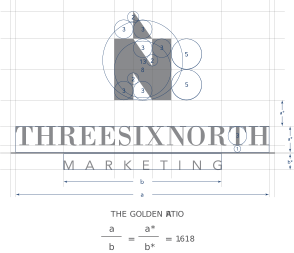
Golden ratio image
The Golden Ratio
Closely related to the Fibonacci Sequence, The Golden Ratio is the most appealing relationship between two or more objects. Its ubiquity in nature and astounding functionality suggests its importance as a fundamental characteristic of the universe. For ages, this ratio has been used in arts, architecture, and now graphic design.
The Parthenon in Greece, the Mona Lisa, and the Apple logo all use the Golden Ratio to ensure a pleasing appearance to the human eye. When something just ‘feels off’, the Golden Ratio can often restore order and create pleasing aesthetics to the viewer.

In part two of this article we’ll take a deeper dive into the specifics of naming, including the types and qualities of effective brand names. Stay tuned.


1Gunelius, Susan. “When and How Do I Have to Use Trademark Symbols”. Forbes.com, 12 March 2014. https://www.forbes.com/sites/work-in-progress/2014/03/12/when-and-how-do-i-have-to-use-trademark-symbols/#6373c4f0c0af

Direct Mail: Does it Work?

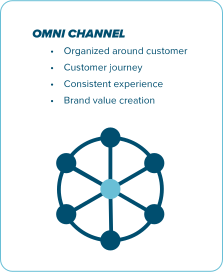
Let’s start by taking a step back and reviewing the difference between traditional Multi-channel Marketing, and Omni-channel Marketing.

Multi-channel is basically what it sounds like, using multiple media ‘channels’ to communicate with a target audience. Each channel is independent of the others.

Omni-channel is similar as it includes the use of multiple channels, however, it is focused around the customer, delivering an integrated brand experience. All the channels are connected together (sharing data with each other), providing a seamless experience.

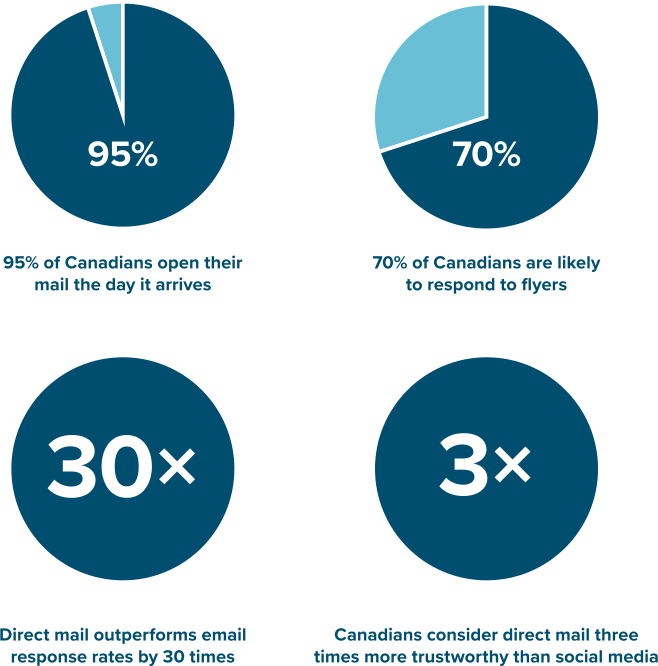
Historically, direct mail has been disconnected from other media channels, and as digital media has taken over, physical media like printed mail and brick-and-mortar retail stores have started to look less relevant. So, is physical media still effective?

Direct Mail acts as a rising tide
Pitney Bowes’ conducted research to quantify the impact of direct mail. What they found was that “Direct Mail acts as a rising tide for all channels… it’s not about physical versus digital but rather the combination of the two driving the best overall performance”. For example, as they dug into the customer journey, it was revealed that many orders were placed by customers who had initially received direct mail, then searched for the company on Google, saw an online ad, and clicked through to the website to place an order. Had the direct mail not been sent, the customer may have never gone to the website, and the opportunity would have been lost.

According the InfoTrends, the media effect when combining web, email, and mobile with print, results in a 45% increase in response rates compared to a digital-only media mix. “Every touchpoint increases the opportunity for brand response”.

One needs to look no further than brands like Ikea and Canadian Tire who have adapted to the digital age, embraced omni-channel thinking, and continue to mail inspiration guides, flyers and catalogs to drive both online and in-store sales.1

This one-piece booklet style mailer provides the target audience with a nicely laid out, easy to digest informational piece that catches your eye much more effectively than a more traditional addressed envelope.
When integrating a postage paid, ‘returnalope’, the user can easily engage by tearing off the envelope portion, filling out the attached donor card, and dropping it into the mail with the postage already taken care of (no need to search for stamps!) By designing content into an eye-catching, single piece mailer as opposed to a multi-sheet mailer or letter in an addressed envelope, we have seen a significant increase in response rates and ROI.

Digital Overload
Managing our overflowing inboxes and pop-up notifications have decreased our attention spans and caused us to swipe and delete messages in the blink of an eye. Printed mail on the other hand, requires a tangible interaction for you to decide if the envelope should be opened.

Direct Mail is Data-driven
With demographic data and route segmentation tools at our fingertips, gone are the days of sending the same mass campaign to everyone. Selling a new furnace, or window replacement? You can target homes that are 20+ years old and instead of wasting money sending it to new homes that don’t require your services.

Print is Physical
Physical solutions enable brands to bridge the digital gap and engage customers with a more immersive experience. Brands like Amazon, Shopify and Netflix are using physical stores and ‘pop-ups’ to provide memorable experiences.2


1Incite, Ideas for Inciting Action, 2020, Issue 1. Canada Post.
2Graphic Arts Magazine, December 2019, this is-not your parents direct mail, Joanne Gore.

Building Your Brand in a Digital World

It’s no surprise that more and more consumers are connecting on digital channels, so the question is: Are you ready?

So what’s the deal with digital marketing?
Well first off, the online world is quickly becoming one of the largest opportunities to connect with your audience. However, it’s important to remember that your brand value relies on far more than a slick digital campaign (think customer experience, market positioning, customer reviews, product design & packaging, etc).

In fact, ‘digital’ should only be one part of your overall marketing strategy.

So while we’re not suggesting dropping traditional marketing tactics from your mix, we are suggesting that the digital world is here to stay and learning how to embrace it is key to reaching the next generation.

“80% of consumers use the internet to find a local business”1

Here’s a brief overview to get us warmed up:

Definition
mar•ket•ing |märkitiNG|: noun
Providing work that matters to people who care.

Purpose
To convince customers you’re the best option!

Brand
The tangible and intangible experience of a product or service.

Tell Your Story
Stories reveal brand personality. You’re either one in a million or one of the millions. STAND OUT! Be different than others in your industry.

You need to be visible online

  • In Canada, 90% of ALL online searches are done on Google2, so that’s where you should focus your energy.
  • Being at the top of the page is important. The top five positions on Google account for over 80% of the search volume. Don’t even think about being found if you’re not on the first page.
  • Even if you’re a local coffee shop or accountant, consumers are not rifling through the yellow pages to find you – they’re searching online.

Claim Your Free Google Listing
A free and easy way to get found on Google is to create (or claim) your Google MyBusiness listing. From here you can take control of your listing and upload photos, store hours, contact information, and even get notified when people leave a review.

Go to business.google.com to get started (or call us at 204-326-6630 if you need a hand getting set up).

Embrace Reviews
It’s inevitable–people will talk about your business whether you like it or not, so why not be in the drivers seat and have the ability to: Learn from what people are saying, respond and rectify situations with unhappy customers, and build a positive following.

Reviews are often deemed as more authentic and trustworthy than the organizations corporate
website so encouraging positive reviews is a great way to rise above.

Google Ads

How do you get in front of your target market if they don’t even know about you yet? This is where Google Ads come in (and how Google makes their money). Setting up a Google Ads campaign can be broken down into 4 steps:

  1. Targeting: reach the user at the right place and right time.
  2. Bidding: set a bid to control how much you pay for users to interact with your ads.
  3. Creative: deliver the right message to the right user. Since everyone is different, we always encourage running multiple different ads (A/B testing to see which performs best).
  4. Measurement & Reporting: review the results and adjust as needed. In the next issue we’ll take a deeper look, show some examples, and highlight the differences between a ‘search’ and ‘display’ campaign.

Email Newsletters

Capturing customer email addresses and sending out special offers and news can be a great way to stay in touch with your customers. Plus it is measurable so you can see how much engagement your emails receive and track if they translate into sales.

Think about the last time you went shopping and the cashier asked for your email address to send you promotions. While it’s employed by all the big brands, from cosmetics to airlines, that doesn’t mean you can’t do it too.

MailChimp and Constant Contact both provide affordable list management & deployment solutions that meet Canada’s Anti-Spam Legislation.

Can we manage it for you? Yes absolutely! We design & deploy eBlasts and track the results to drive your sales and marketing goals.

Visual & Inspiration

Groups, Dialogue, Friends

Instant, Succinct

Social Media

Probably the most common issues we see with local organizations using social media is not understanding that different channels require different messages.

Remember that it’s not free (what is the value of your time?), not all channels are a good fit for all organizations, and is it actually building your brand (Return on Investment)?

Also remember to have a good mix of content, don’t just shout the same ‘hard sell’ message over and over. Rather focus on providing value to your followers and sharing helpful information. Engage your audience.

Digital Marketing Terminology

Analytics
Analytics is the analysis and communication of data. Usually a report or dashboard can help organize the data into meaningful insights to drive decisions and measure the effectiveness of a campaign. Data can include page visits, impressions, clicks, time on page, etc.

Bounce rate
Did people leave your website without ‘converting’? Bounce rate measures the percent of website visitors that leave without browsing further and can be an indication that your landing page may not have a clear call-to-action, or is different from what people expect when they arrive.

CASL
Canadian Anti-Spam Legislation – requires organizations to obtain permission from recipients before sending communications out to them via email. They must also include an opt-out method without delay. CASL requires that senders maintain proof of opt-in, including the source and time.

Clicks
Clicks measures how many people are actually clicking on a link or ad, and going to a specific page on your website to learn more. Industries have different benchmark ‘click through rates’ meaning out of 100 people, how many people we should expect to click on the ad.

Conversions
If we understand what we want people to do when they get to your website (eg. download a PDF, phone you, etc), we can measure these behaviors as conversions.

Geotargeting
The strategy of delivering different content or ads to users based on their geographic location. This allows you to be hyper targeted with your budget and message.

Impressions
Similar to driving by a billboard on the highway, impressions measure the number of times people see your ad.

Mobile-Responsive
Refers to a website that is easy to use on a mobile device and dynamically adjusts the layout to best fit the screen size. Today, over 50% of all web traffic is from mobile phones, and if your website doesn’t meet Google’s latest mobile compatibility standards, they can penalize you in Google search rankings.

SEM
Search Engine Marketing – these are the ads that you see popping up around the web, or the first couple text results at the top of a Google search. SEM is a way to drive traffic to your website and get in front of an audience where you otherwise are not ranking well (can target by geography, demographics, keywords, etc).

SEO
Search Engine Optimization – basically this is how a website ranks on Google search results. There’s a number of items that contribute to a strong search ranking including the technical way the site is built (coding, mobile responsive, load time, links, etc.), and the amount of actual relevant content and keywords on the pages.

The more optimized your website is for SEO, the better chance you have of being found online.

SSL
Secure Socket Layer is a web security technology on your website that protects and encrypts information entered by users over the site. It’s important because browsers are now warning users when a website is unsafe to enter.

Without SSL, your website will get flagged and visitors may be deterred from visiting the site. If your site is SSL Secure, visitors will see a green lock icon in the address bar, indicating it is safe.

“98% of searchers choose a business that is on page 1 of the results they get.”1


1Frost, Phil. “15 Stats That Prove Google Adwords Is A Great Investment For Your Business”. May 21, 2017, https://www.mainstreetroi.com/15-stats-that-prove-google-adwords-is-a-great-investment-for-your-business

2“Search Engine Market Share Canada, August 2017 – August 2018”. Statcounter GlobalStats, 2018, http://gs.statcounter.com/search-engine-market-share/all/canada/#monthly-201708-201808-bar

What is SEO and Why is it Important?

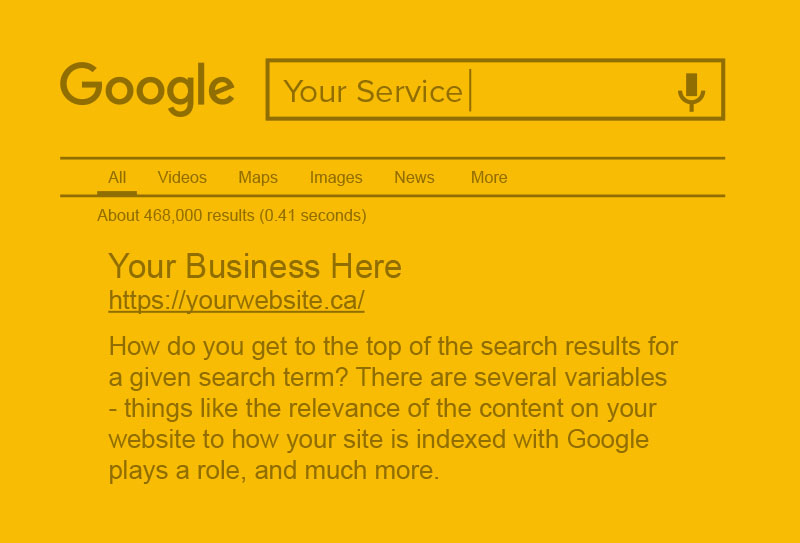
Recent studies show that 86% of consumers use the internet to find a local business, and over 90% of Google users don’t bother to look beyond the first search results page. This means that if you’re not on the front page of Google, you’re not being found.

So, what is SEO?
SEO, or Search Engine Optimization is the process of increasing the visibility of your website to attract more people, and gain higher quality visits to your site (focusing on your target market and people who are likely to become a customer).

Simply put, it’s the art of getting more valuable, relevant traffic to your website by making your website searchable through non-paid (organic) search results.

Google, the most widely used search engine, processes over 40,000 search queries every second1, and with over 130 trillion pages across the web, the importance of securing your spot at the top is increasing, as is the competition. Even a small increase to your SEO can mean the difference between a customer choosing you over the competition.

Google search 101:
Even before you search for something, the Googlebot is busy crawling and storing sites in its Search index, looking for new or updated web pages.

Google then analyzes the content of the page, cataloging and indexing images, videos and text, essentially coming up with an understanding of what the page is all about.

In less than a second after you initiate a search query, Google serves back results from its index of over 30 trillion unique sites.

“If you’re not on the front page of Google, you’re not being found”

Then, Google monitors what happens and adjusts your page rank accordingly – if they believe many users are finding value spending time on your site, they will continue sending more traffic to your site and may even move you up on the Google search page. However if users are leaving quickly and trying another search, Google may adjust it’s results to deliver other options, and move your site down in the rankings accordingly.

The SEO ‘Game’
Google has over 200 different ‘signals’ that it uses to analyze a website and determine it’s placement on the SERP (Search Engine Results Page). Each of these signals carries a different weight,  from nearly insignificant to absolutely critical, and they all play a part in the overall success of your website.

However, Google is constantly iterating their algorithms, policies, and practices in order to push the envelope and maintain their status as top dog. Because of this, the SEO landscape is always changing, and what was best practice one day can be yesterday’s news overnight.

The trick to staying on top of this is knowing that all of Google’s metrics for ranking ultimately seek to answer two questions: does this website have what the user is looking for, and is the website providing the best possible experience? This means that starting off with the strong foundation of having your website designed and built with SEO in mind gives you an advantage over your competitors.

Keys to good SEO
It is helpful to understand the relationship between a search engine and its users when considering SEO.

Search engines form a symbiotic relationship with their users: the better they do at  providing users with exactly what they are looking for, the more likely a user is to come back and use it again. This increases the odds that they will click on ads or sponsored content that generates revenue for the search engine.

This means the ultimate goal of Google et al. is to find websites that are as relevant to what people are searching as possible, and to make sure its users have the best experience possible on it’s platform.

Three Pillars of SEO
1. Content – Content is the main reason people want to visit your site, and as a result it has a major impact in your SEO. Good content engages users and entices them to stay on the page longer. On top of that, people are more likely to share good content which increases site traffic, and when those users engage with and share your content the effect starts to snowball.

2. User Experience – If we compare a website’s content to a dish at a restaurant, the user experience is the menu that helps you find what you want to eat. User experience (UX) encompasses many factors that influence how people feel about your website. When designed well, most people won’t notice (when was the last time you heard someone say, “That button is just the right size to be clicked on!”); but when done poorly it is the first thing that will turn people away. All of Google’s metrics for ranking are ultimately seek to answer one of two questions: does this website have what the user is looking for (content), and is the website providing the best possible experience (UX).

3. Indexability – It doesn’t matter if you have the greatest content on the internet, if Google’s bot can’t find what it’s looking for, your website won’t show up in a search. It’s important to not only display information in a way that is good for your users, but also in a way that makes it easy for the bots to discern what you’re talking about.
So, what does it take to boost your SEO?
Time. There is no ‘magic’ when it comes to optimizing your website for search engines. It is a culmination of hundreds of small factors, and can take months for a dedicated SEO project to show results. By making Search Engine Optimization a factor in your marketing strategy and consistently making improvements, you can build a strong SEO profile over time. As your website builds momentum, the increase in traffic will help fuel further growth and development.

Optimizing your website for Search Engines is an ever-changing and competitive discipline. As the digital landscape evolves, so too does SEO. Google regularly updates their algorithms and new factors impacting SEO are frequently discovered. If you’re not staying on top of the change, you risk losing your search result spot to someone who is.


Could you benefit from an SEO boost?

Here are a couple of quick checks you can perform:
Go into your web browser’s ‘Private’ or ‘Incognito’ mode so that Google doesn’t use your previous search data, and perform a few searches on Google for your website, your industry or services, and specific content on your website.

If you’re on the first page, you’re doing okay, if you’re on the top half of the page, you’re doing well, and if you’re ‘above the fold’ (the search results that show up before Google’s other widgets), you’re doing great.

First 3 Non-Paid Results Your Rank
Your Website
Your Industry or Services
Specific Content on Your Website


1Google Search Statistics, www.internetlivestats.com/google-search-statistics

Taking the Long View

Why commitment to long-term growth prevails over short-term gains.

my·o·pi·a

/mī’ōpēə/
noun

  1. nearsightedness.
  2. lack of imagination, foresight, or intellectual insight: a narrow view of something.

Taking the long view and fighting off the pressure to deliver short-term results and quick growth is essential. Why? Because quick gains and shortcuts usually don’t last, and then we’re right back to where we started. Not only have we seen the benefits to an organization as they take a step back, see a clear path, and execute a consistent strategy; we also see a real need for marketers to choose this path to remain effective. Consumers today have little trust for advertising, coupled with decreased attention spans, and a surplus of choice­—we simply can’t afford to be short-sighted.1

Workplace Culture
In a transparent world, the walls of your organization have turned to glass. Your internal culture is your brand. As consumers shop with their values, and employees seek out organizations that fit their values, fostering a vibrant intentional culture is more important than ever.2

There’s been a massive shift in consumer buying trends moving away from a focus on the lowest price (resulting in a race to the bottom), to seeking out brands that align to their values. Consumers are concerned with an organization’s values and look for transparency; how they treat their employees, how they care for the environment, their mission, etc. In this sense, workplace culture is a differentiator and something that attracts loyal customers.

While culture cannot be created overnight, a long-term approach to investing in your internal culture pays off externally by creating customers that are with you for the long haul (think customer lifetime value). What happens inside your walls, will eventually become a part of how those outside your walls view you, or as Ken Blanchard put it: “profit is the applause you get for creating a motivating environment for your people and taking care of your customers”.

When we think of corporate culture, Southwest Airlines comes to mind. Southwest has consistently outperformed the industry, and many books have been written about their success; largely credited to their culture—even their stock market symbol (LUV) reflects their caring culture.

Culture isn’t some warm and fuzzy team-building exercise with inspirational posters on the wall, it’s about how you behave and how you make decisions—it’s about taking the long view and instilling values. So if it works, why haven’t others copied Southwest? Because culture is unique and hard to copy! Southwest has a team dedicated to developing and maintaining their culture, fostering this deliberate differentiation strategy since its inception.


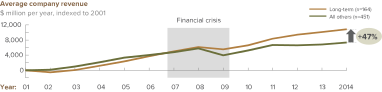
SOURCE: McKinsey Corporate Performance Analytics; S&P Capital IQ; McKinsey Global institute Analysis


Financial Results
McKinsey & Company conducted research to measure the impact of short-termism and found that companies that operate with a long-term view outperformed their peers in almost every financial metric over a 10+ year period!

When large publicly traded companies such as Unilever and Amazon stick to a long-term view and resist the immediate pressures from Wall Street investors, they’ve consistently delivered superior results. These metrics include revenue growth, job growth, and even market capitalization.3

So what exactly are these ‘long view’ companies doing differently? Two areas that the research identified showed they maintained consistent and sustainable sources of growth, and invested significantly more in Research & Development than their peers. During the financial crisis of 2008, they continued to invest while others cut their R&D spending. By investing in this future growth and remaining committed to their long-term goals, these companies were rewarded with much higher gains when the economy recovered, leaving their peers behind to play catch-up. In summary, they stuck with their game plan.

“companies that operate with a long-term view outperformed their peers in almost every financial metric over a 10+ year period!”

Corporate Stewardship
According to a multi-stream management approach, the triple bottom line includes balancing Financial, Social, and Environmental performance. We’ve already addressed the financial and social (workplace culture) aspects above, so what does taking the long view mean from an environmental perspective? How about leaving the world a better place; treading lightly so as not to leave a lasting negative impact for future generations?

It makes good business sense to ensure you’re behaving in a sustainable way that sets the foundation for operational longevity. In fact, it likely ties back to the purpose of why you exist. One of our core values is Stewardship; actively caring for the community and environment by doing the right thing. Fortunately, we are surrounded by many wonderful corporate stewards in our community and don’t need to look very far to see businesses that are modeling this well through volunteering, funding non-profits, sponsoring sporting events and the arts, ultimately building a stronger community together.


1Dominic Barton, James Manyika and Sarah Keohane Williamson. “Finally, Evidence That Managing for the Long Term Pays Off”. Harvard Business Review, 9 Feb. 2017, https://hbr.org/2017/02/finally-proof-that-managing-for-the-long-term-pays-off

2TrendWatching, Glass Box Brands https://trendwatching.com/quarterly/2017-09/glass-box-brands/

3Esme Rottschafer, Incite Magazine, 2020 Issue 1

Using Colour to Your Advantage

Think “School Bus Yellow” and immediately your mind’s eye finds that exact colour. Certain combinations of colours can evoke strong emotional responses—like the colours of a memorable brand or your favorite sports team. Colour is a tool that can be employed to portray a mood, create a desired path of eye movement, apply emphasis, organize hierarchy, and the list goes on.

There are many variables that come into play when establishing a brand’s colour system. Take for example, the differences in online and print media. Selecting colour for online use is different than print, in that websites are displayed on a digital device, and the colour functions of those devices require use of a colour palette referred to as the RGB (red, green, blue) colour model. These three colours are combined in various ways to create the colours you see on digital devices and are expressed as a hexadecimal number that corresponds to a colour.

While the digital world has RGB and hexadecimal colours, the print world has CMYK (cyan, magenta, yellow, black). Branded merchandise such as clothing and apparel can add yet a whole other dimension to consider.

Consistency
Creating consistency in each interaction your customer has with your brand is an important part of conveying a credible, memorable message. When your iconic blue sways enough to be interpreted as purple, people take notice.

But even in the most colour conscious environments, colour will not always be an exact match when things like substrate types or print methods differ. And colour between digital devices can differ slightly from one to the next. So how is consistency achieved? Starting with carefully selected colour formulas, documenting colour systems in a brand guide, and implementation through a proper colour management workflow ensures consistency is optimal across print and digital mediums.

What colours to use?
Typically, one or two base colours and one or two accent colours are a preferable structure to work within. However, tastefully stepping outside of common boundaries can be the catalyst to setting yourself apart from the rest.

The use of accent colours can bring attention to “Call to Action” elements. The most important aspect of this combination is harmony. By choosing complimentary colours or pairing a colour with a neutral one for example, you can get combinations that are both appealing and legible.

The hue of each of these colours can dramatically change the effect on the viewer. A deep royal purple can provide a feeling of elegance whereas a light lavender colour may come off as more feminine and soft.

So how does one determine which colours to use? In addition to observing your industry and aiming for a unique palette, selecting colours based on their most common psychological associations is a good place to start. Here is a brief list:

Warm Colours
Red: Boldness, energy, passion, urgency, caution, affection
Orange: Enthusiasm, creativity, friendliness, emotional, fresh, autumnal
Yellow: Optimism, cheerful, youthful, active, approachable
Pink: Femininity, fertility, romance, edgy

Cool Colours
Green: Growth, health, tranquility, nature, reassuring, fresh, affluence
Blue: Stability, security, trust, peaceful, devoted, dignified
Violet: Regal, success, wisdom, wealth, honour

Neutrals
Brown: Organic, resourceful, timeless, robust, natural
Gray: Simplicity, neutrality, futuristic, calming
White: Pure, wholesome, cleansing, restful
Black: Sophisticated, elegance, luxury, edgy

Is your brand’s colour palette accurately portraying your organization with consistency?


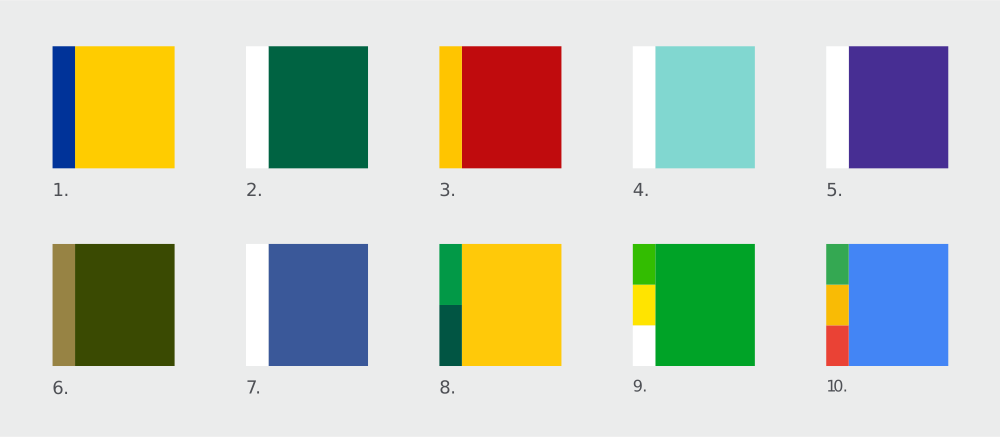
Can You Identify the Brand?
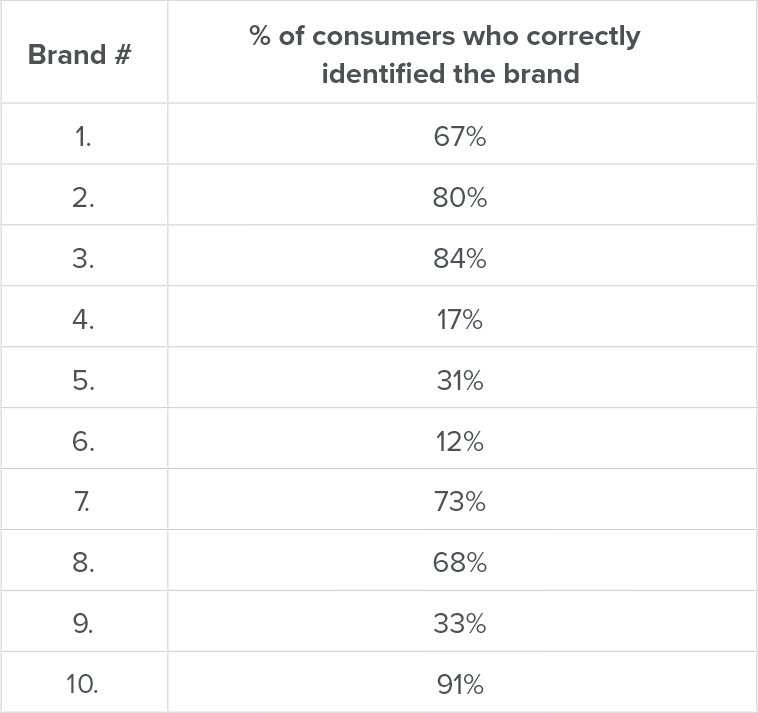
Below are some of the most recognizable brands in the world. Check your answers below. Compare your recognition capabilities with the results from the original survey in the table below.

Answer Key

Communicate Product Value

Did you know seventy-five percent of consumer purchase decisions occur in less than ten seconds?1 This confirms what most of us feel intuitively: in our highly competitive markets, only effective packaging will cut through the clutter and communicate value. A products’ perceived value is elevated by good presentation—the inverse is also true. Remember: perception drives value.

Careful consideration is important when determining key features like package size, shape, special finishes, and label design. Planning ahead means gaining great efficiencies and avoiding future compromises. For example, establishing versatile design systems to handle multiple product varieties and future releases ensures smooth adaptation and optimal recognition.

Naturally Powerful Bags


Beyond the aesthetic and experience, packaging must also serve functional necessities. This can include protecting products from damage during transport, satisfying food-grade requirements, being easy for retailers to shelve, and adhering to specific Consumer Packaging and Labelling Act guidelines (in Canada—America and international requirements will differ).

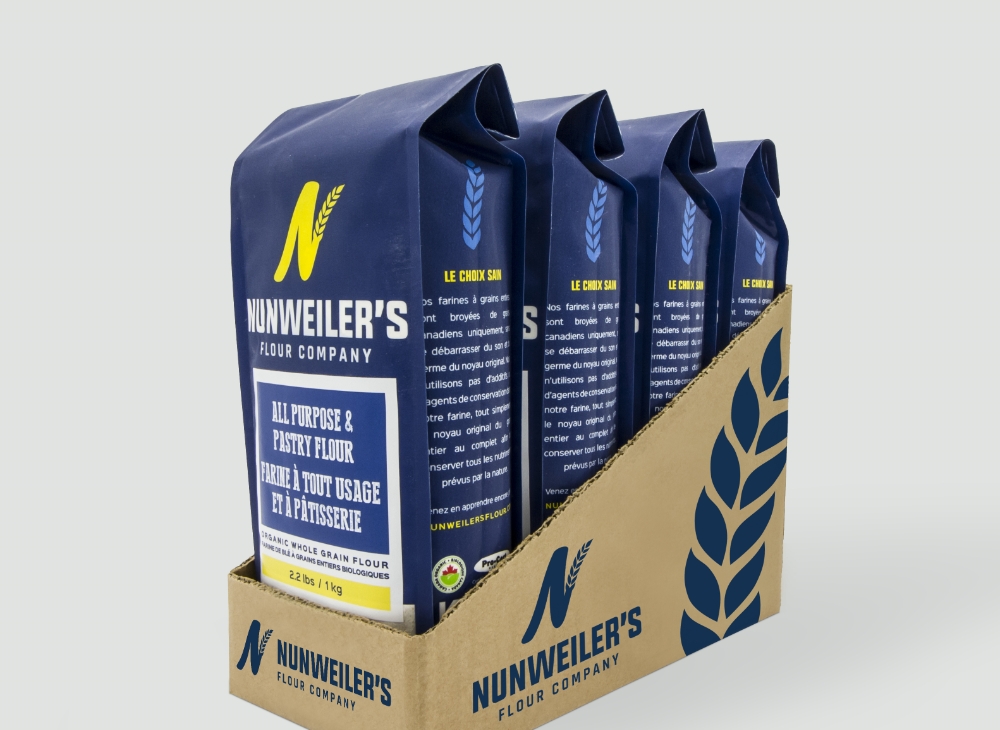
Nunweilers Packaging


With packaging waste being at the forefront of consumer minds, many businesses are moving toward environmentally friendly options such as paper; when recycled, paper is one of the few truly sustainable products. According to the Paperboard Packaging Council (PPC), virtually all paperboard consumed in North America today comes from farms where trees are planted, harvested, and replaced. Five trees are planted for every tree is harvested for paper, and these young trees soak up more carbon dioxide than older ones.

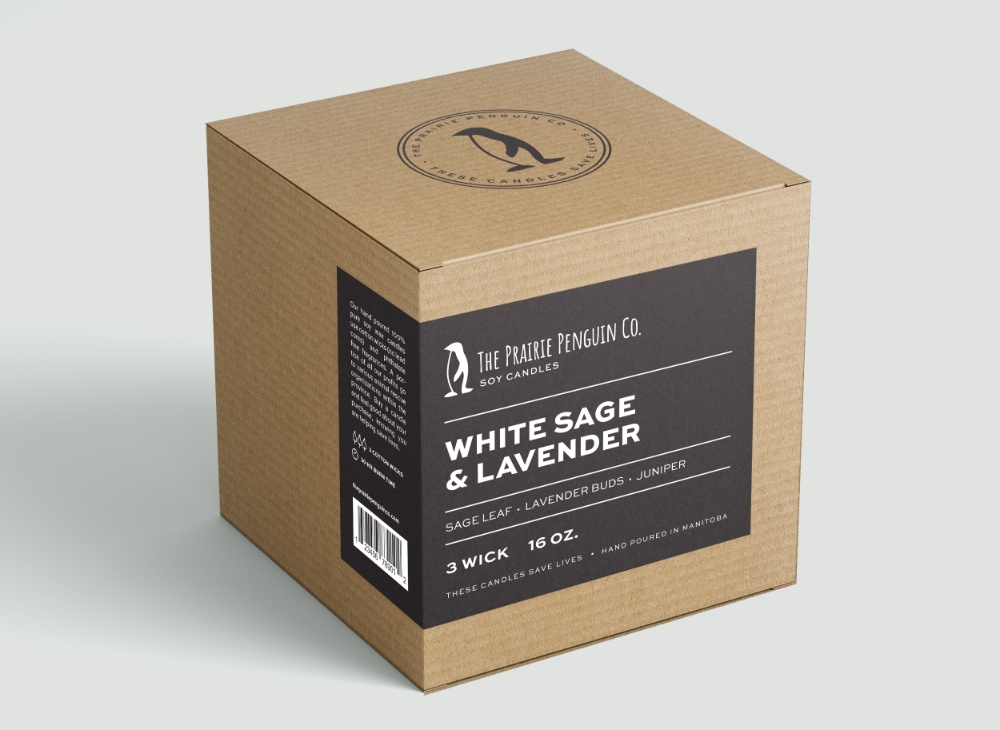
Prairie Packaging


After the functional and aesthetic needs are satisfied, packaging production and ongoing fulfillment follow. Get in touch with us to talk about your next packaging project. Our flexible run sizes and in-house design and production capabilities make for an effective and efficient process from concept to completion.


1. Dalton, Alyssa. “Spotlight” PrintAction, vol. 58, no. 5, June 2019, pp. 38

Why Does Brand Matter?

Brand is a wide-ranging topic with a lot of moving parts. Today we’ll keep it simple and take you on a short sprint through some of the fundamentals of building awareness, and why they matter. In a future article, we’ll look at the tactics and tools we can implement.

Let’s begin. Relevant brand awareness and recognition are facilitated by a communication strategy and visual identity that is easy to remember (clear, succinct), is immediately recognizable (unique, thoughtful), and helps to answer the following questions:

  • Who are you?
  • Who needs to know?
  • How will they find out?
  • Why should they care?

Taking steps toward successfully answering these questions through your communication strategy and visual identity requires a deep understanding of your industry, your capabilities and fit, your audience, along with some finesse. What are some key areas we’re looking to focus on when building a brand effectively?

City

1. Credibility
A logo or other branded asset often plays a big role in the first impression made about your organization. Well-designed brand identities build trust with their audiences from the start. Brand is more than just a logo—the visual identity is a foundational piece of the brand structure that should facilitate accurate portrayal and ease of application of the brand in the mediums it lives in.

2. Communication
Every interaction with an audience provides an opportunity for building relationships and conveying your value proposition. Consistency here is key, and if you can do it with genuine tone, humor, tasteful flare, or some unique approach, even better. This can be done through more tangible items like signage, mail campaigns, and digital media, as well as the less tangible items, like how clients are greeted or how they are guided through the customer journey.

3. Recognition
A brand creates an impression, image, and trigger in the minds of an audience (good or bad). Effectively defining, developing and communicating a brand to an engaged audience, new audiences and employees increases loyalty and long-term relationships. With dedication and doing this well over time pays dividends, taking your product or service from the lesser-known to the well-known.

Some might argue that sales are always fine (through word of mouth or otherwise) and investing in awareness and recognition isn’t important. This can be true for some specialists that experience very little disruption or the prospect of competition in the long run. For most though, competition and changing markets eventually come around and the ensuing, reactionary brand-building needed is often too late and leaves one playing catch-up.

Maintaining a devout focus on the details surrounding credibility, communication, and recognition on each project will create brand equity growth.

Flourishing Amidst Disruption

Let’s be clear: the situation many of us found ourselves at the height of the COVID-19 pandemic was not a welcome one. It would be remiss not to acknowledge that the disruption to the lives we’ve built, the activities and routines we do to socialize and relax, and the industries we work in, create interconnected stress points for more people than ever before. Doubts can move in about the resiliency of our organizations and our own character. But there is hope.

Disruptions can reveal deficiencies we didn’t otherwise see before and allows us to improve upon them. It sparks motivation to creatively adapt and innovate, and for some, the future of their organization depends on it. Disruption also provides the opportunity to implement new positive processes in our routines to replace the ones we no longer have access to.

Person

What Can We Learn?
Disruption gives us a highly concentrated dose of information about opportunities for improvement.

  1. It reveals the mistakes we were making that we were not paying for, but now are. Those pain points are sure a good motivator for improvement (both as an organization and individually).
    • For example, relying on one revenue stream that has now declined may now be a motivator for many to work harder at finding ways they can build diverse revenue streams.
  2. Perhaps we can improve on fundamentals?
    • Find new customer groups who we can reach now and without major ‘re-tooling
    • Retain bigger cash reserves
    • Focus on what really matters
    • Make time for long-term, strategic planning
  3. View disruption as a motivator that initiates growth earlier than it otherwise would, bringing the benefits to fruition faster.

What Can We Create?
Disruption requires us to be innovative.

  1. It pushes us to find new solutions to things we wouldn’t otherwise be motivated to solve.
  2. How can we connect with our audience in a different way that is relevant and meaningful for them in these current times? Are there new groups we can connect with within the immediate future?
  3. What needs have been born from this disruption that fits your capabilities. Do any of them fit with your current audience or is there a new audience that could benefit from your skillset?
Bakery
A sourdough starter set from the acclaimed Brooklyn bakery, Bein Cuit enables consumers to produce fresh products from home. (Image courtesy The New York Times)

What can I Improve/Change?
Disruption allows us to re-engineer our routines.

  1. We rely more heavily on driving benefits from the good parts of our routines (e.g. the things that keep us focused and productive, the things that give us relief from the daily grind, the things that meet our needs and help us flourish, etc.).
  2. Falling into bad habits can become a problem if we leave our routines on “automatic” during massive disruption. We need to make conscious decisions to adjust and adapt to our new surroundings so we do not devolve into bad habits.
  3. Add as many positive processes as possible and remove any negative processes.
  4. Perhaps there are things about my habits or routines personally that can be learned from this disruption? What really matters? What can I keep doing, do more of, or do less of?

Let’s Recap:
Keep in mind these three fairly universal opportunities we can seek during this time:

  1. Think about opportunities for learning.
  2. Think about opportunities for creativity.
  3. Think about how we can re-engineer our routines.

It is our hope that these opportunities can help you leverage this situation into something good. Let’s encourage each other to look forward and create things for ourselves to look forward to within the disruption, leading us to progression, not regression.